E-BOOK
Building for What's Next
The PRODUCT-MARKET-EARTH FIT™ guide to products people want, businesses need, and the planet can sustain
The team behind Product-Market-Earth Fit™

Renee Davis
5x Head of Product, Fractional CPO, and founder of Climate Conscious Leaders. Passionate about helping leaders embed sustainability into product strategy, decision-making, and innovation.

Anu Sanghvi
Championing under-resourced entrepreneurs | Entrepreneurship Director, Makahakama Foundation | Co-founder, Greenhouse Women
Chapter 01
Why Now
The Moment We All Recognize
It’s 9:17 a.m., and stand-up has just wrapped. The team is energized. You’ve shipped a new feature — not a moonshot, but a meaningful improvement that reduces friction and adds clear value to the user experience.
Dashboards tick upward, Slack messages pop up with 🎉 and “Nice work,” and someone says, “We moved the needle.” It feels good, because this is what progress looks like in the tech product world: small wins, sprint after sprint, momentum you can point to.
The team showcases the update at All Hands and enjoys the brief win. By the next day, attention has already shifted to the next backlog item, the next sprint, the next initiative.
All this while, something else is quietly taking shape in the background — something almost no one on the team is tracking: the product’s carbon footprint.
The Invisible Accumulation
As your product usage grows, so does the shadow of its unseen carbon footprint. Servers spin up to meet increasing demand, AI models process and respond to user requests, and data is constantly transferred, duplicated, cached, and stored. Cloud data centers hum around the clock, consuming electricity and water in massive quantities.
No single decision feels particularly significant. Each feature appears additive, each optimization harmless. Yet together, these decisions and their corresponding carbon footprint compound over time — day after day, sprint after sprint, year after year.
In 2025, the technology sector produces roughly 1.2 billion tons of CO₂ annually, comparable to the aviation industry’s global emissions from nearly 39 million flights each year. That’s a lot of CO₂! And, it’s ever-increasing with the rapid integration of AI across companies, products, and services. By 2040, tech’s share of global emissions is projected to increase 250%!
It raises a difficult question: how did something with impact at this scale remain so invisible for so long?
The Questions We Rarely Ask
Consider a typical product planning cycle. We debate user needs, technical feasibility, and delivery timelines. We prioritize by effort and impact. We track conversion, engagement, retention, and churn. But we rarely pause to ask what the environmental cost of a feature might be, or whether an update encourages sustainable user behavior or extractive behavior, or whether the same outcome could have been achieved with less compute, less storage, and/or less waste. A feature’s carbon footprint almost never appears in our metrics or dashboards.
Even in retrospectives, our conversations usually revolve around velocity, quality, and execution rather than deeper questions: Are we over-engineering for scale we don’t yet need? Are we storing data long after its useful life has passed? Did we apply AI when a simpler, more efficient approach could have sufficed? For many teams, the energy and environmental costs of their products simply do not enter the decision-making process.
The Myth of Weightless Software
For decades, we built technology and SaaS products as though computing power were limitless and data storage was effectively free. Software felt clean and abstract, untethered from the physical constraints that defined earlier industries. There were no smokestacks, no shipping pallets, no factory floors. It was easy to experience digital products as pure logic: efficient, scalable, and immaterial.
Yet digital has never been immaterial. Every product runs on physical servers. Every cloud lives in a physical data center. Every byte depends on land, minerals, water, energy, and human labor. As products grow, so does the infrastructure required to support them. Servers spin continuously. Data is stored, duplicated, and transferred across continents. Energy is consumed not once, but continuously, as long as the product exists. What appears effortless on the surface is sustained by vast physical systems operating out of sight.
At the level of a single feature or a single product, these impacts can seem negligible. No individual decision appears significant on its own, but software does not exist in isolation. Features accumulate. Users multiply. Products scale. Companies expand. And the entire technology sector grows alongside them. What begins as thousands of small, invisible footprints gradually merges into something much larger: a collective impact measured not in kilobytes or server instances, but in gigatons of emissions, vast resource consumption, and planetary-scale infrastructure.
Yet because these systems remained largely invisible to the teams building and scaling software, their costs are rarely factored into decision-making. There were no visible signals to suggest limits, no immediate feedback loops to indicate consequence. Features shipped. Usage grew. Infrastructure expanded quietly in the background.
Without ever explicitly choosing it, we began operating as though digital growth carried no meaningful physical constraints, and as though the systems supporting it would scale indefinitely to meet demand.
Over time, this absence of visible constraint shaped more than individual product decisions. It influenced what we measured, what we optimized for, and how we defined success. Growth became the primary signal of progress. Efficiency was measured in speed and scale.
The underlying assumption was simple and rarely questioned: the role of technology was to expand, and the systems beneath it would absorb the impact.
That assumption quietly shaped everything that followed.
An Outdated Operating System
For decades, we have been running modern civilization — and modern product development — on an operating system that no longer matches the world we live in. We were trained to optimize for growth, speed, and efficiency: faster sprints, bigger funnels, higher adoption, higher margins. Impact was measured in market traction; efficiency was defined by developer velocity; growth, by definition, was considered good. That logic made sense in a world where the servers were somewhere else, the energy came from somewhere else, the raw materials came from somewhere else, and the waste went somewhere else. The costs stayed distant and abstract, safely out of view.
What’s surprising is that this mindset didn’t emerge recently. The way we’ve defined progress and business success has been fundamentally one-sided for more than two centuries, stretching back to the Industrial Revolution of the 1830s. Since then, we’ve pursued productivity, convenience, and speed with remarkable success.
Each leap forward in technology has delivered extraordinary human benefit. At the same time, it has quietly accelerated environmental extraction, emissions, and waste on a planetary scale.
That operating system might have worked (temporarily) for the world we inherited.
It does not work for the world we are stepping into.
The Push Back
Outside our roadmaps and sprint cycles, the planet is responding.
The massive amounts of carbon that have silently accumulated in the atmosphere are now loudly destabilizing our climate and weather systems. This has been apparent to Climate Scientists for quite some time, but for most of us, the reality of global warming has never been as visible as it is today. For the first time, extreme weather events are happening with alarming regularity — storms, floods, and fires that used to be hundred-year events are now headlining the news multiple times a month.
The data is stark. In 2024, the United States experienced 27 separate billion-dollar weather and climate disasters, resulting in at least 568 deaths and $182.7 billion in damages. In 2023, there were 28 such events. Since 1980, the cumulative toll has reached 403 disasters costing over $2.9 trillion in recovery. The chart below shows the average frequency of billion-dollar weather events by decade in the United States, illustrating the rapid escalation we are living through. This is not just inconvenient — it is costly, disruptive, and showing no signs of slowing.
Source: NOAA Climate Data
But the planet is not the only force pushing back.
Customers are pushing back, too.
Consumers are increasingly making decisions through a sustainability lens. 60% of global consumers now prefer to buy from brands they perceive as sustainable, and 58% actively avoid companies they believe are environmentally irresponsible. 78% of U.S. consumers say sustainability is important to their lifestyle, and 62% are willing to change their purchasing habits to reduce environmental impact.[1][2]
This shift is already reshaping markets. Products making environmental and sustainability claims are growing faster than those that do not, and consumers are rewarding companies that align with their values. Sustainability is no longer a niche differentiator. It is rapidly becoming a baseline expectation.
For decades, financial performance was evaluated largely in isolation. Today, investors increasingly assess companies based not only on revenue growth and margins, but on how that growth is achieved. Environmental, Social, and Governance (ESG) metrics have become a core part of investment analysis, helping investors evaluate long-term risk, operational resilience, and sustainability exposure. ESG ratings and lifecycle assessments now influence capital allocation decisions, signaling which companies are positioned to thrive in a resource-constrained future and which are not.[3]
At the same time, companies themselves are responding to this pressure. 82% of organizations plan to increase investment in environmental sustainability, driven by regulatory requirements, stakeholder expectations, and the need to future-proof their business models.[4]
Markets are pushing back.
Regulators are introducing disclosure requirements. Supply chains are becoming more volatile. Energy costs are rising. Infrastructure is under strain. The assumptions that once allowed digital growth to scale frictionlessly are beginning to break down.
For those of us building products, these disruptions aren’t just numbers — they ripple through the interconnected systems that power everything we create. They affect users, operations, supply chains, capital flows, and the companies we build. Every disruption has tangible consequences that shape how we design, deliver, and scale.
As climate impacts accelerate and stakeholder expectations shift, the infrastructure our products depend on is becoming more fragile and costly, from energy and grid reliability to supply chains, raw materials availability, insurance, and financial risk. A warming planet is no longer a distant externality; it is now a persistent constraint on how we operate, innovate, adapt, reinvent, and ultimately define what ‘good’ product looks like. And constraints have always been the catalyst for innovation.
The question is no longer whether our operating system will need to change.
The question is whether we will update it deliberately — or be forced to by the systems around us.
Every generation inherits the systems that defined progress before them. And occasionally, when the world changes, those systems must be rewritten.
Chapter 02
The Operating System Update
Our current OS and where it falls short.
The Origins of Product–Market Fit
In the early 2000s, venture capitalist Andy Rachleff introduced the concept of Product–Market Fit (PMF), later popularized by fellow investor and entrepreneur Marc Andreessen as the ultimate milestone of startup success and a fixture in the Silicon Valley lexicon. PMF describes the magical moment when a product meets strong market demand. It became the north star of modern entrepreneurship — the point where desirability, viability, and feasibility align so tightly that growth feels almost effortless.
For more than two decades, PMF has been the holy grail of product success.
We measured it in acronyms such as TAM, SAM, and SOM, and through metrics like retention, NPS, and churn. We optimized funnels, tuned business models, and shipped features that moved the numbers in the right direction. PMF worked. It gave rise to industries, to empires, and to the playbook for building modern technology companies. More than a framework, it became a mindset — a shared language for turning ideas into traction and traction into scale.
But even the best frameworks reflect the assumptions of their time.
PMF emerged in an era that treated technology as weightless: limitless computing power, free storage, invisible infrastructure. It focused on customers and capital, not carbon or climate.
In retrospect, that blind spot made sense. The internet felt infinite, the cloud seemed abstract, and growth was treated as inherently good, not something to question or balance.
Today, we know better. Today we recognize that every product we build draws from the same interconnected systems of energy, water, minerals, and land — the real resources that power everything humans create. There are no products without the resources that sustain them.
Connecting the Dots: PMF, Business Models, and Frameworks
If we step back, Product–Market Fit is only one part of the operating system we’ve been running. The full OS combines three core elements:
- The North Star — PMF: Defines what success looks like: do enough customers want this? Customer demand drives the signal for “winning.”
- The Growth Engine — Business Models: Determines how that success scales, whether through subscriptions, transactions, engagement, or SaaS usage. The engine converts fit into fuel for growth.
- The Execution Tools — Frameworks: Tools like Agile, Lean Startup, OKRs, Design Thinking, and Jobs to Be Done help teams optimize speed, efficiency, and desirability. They guide how work gets done and how the growth engine is managed.
Together, these three components form the operating system that has guided modern product development. When aligned, traction, adoption, and revenue all point to “success,” and growth feels effortless.
Where Our Frameworks Fall Short
As modern product builders, we inherited a powerful set of frameworks, best practices, and mental models that were forged inside this old operating system. They thrived in a world that assumed effectively infinite resources and limitless capacity for the planet to absorb the side effects of growth. Today, that assumption is visibly false. The result is a growing mismatch between how we build and the physical reality our products now operate within.
| Framework | What It Assumes / Optimizes For | What It Misses (Gap) | What It Could Become |
|---|---|---|---|
| Agile & Scrum | Speed, iteration, velocity; delivering value quickly | Ignores energy footprint of frequent builds, deployments, and growing infrastructure | Integrate energy-aware dev practices; prioritize low-impact architecture alongside velocity |
| OKRs | Aligning on measurable business outcomes; inputs vs. outputs, leading vs. lagging indicators | Environmental impact isn’t part of “key results,” so it never becomes a success metric | Track carbon footprint, resource intensity, and energy efficiency — and advance carbon-negative impact through circularity, regeneration, and carbon absorption, so scale creates net positive impact for the business, customers, and the environment |
| Lean Startup | Reducing build waste; validating fast; efficient experimentation | Doesn’t consider downstream resource waste or impact once the product scales | Add lifecycle impact checks to MVPs; evaluate environmental cost per iteration |
| Design Thinking | Human-centered problem solving | User actions that drive resource use, consumption, and emissions aren’t examined | Expand to “human + Earth-centered design” that accounts for behavior-driven footprint and designs for circularity, carbon-negative production, and business models that strengthen social, environmental, and ecological resilience over time |
| Jobs to Be Done (JTBD) | Customer progress and desired outcomes | The “job” never includes planetary needs; implicit assumption of unlimited resources | Define the job to include environmental constraints and regenerative outcomes |
None of us designed this operating system. We inherited it. We learned to succeed within it. And for a long time, it worked. But when the tools we rely on never ask about carbon, energy, materials, or waste, they quietly train us to treat those costs as irrelevant. The next step is not to abandon these frameworks, but to deliberately extend them.
By doing so, we evolve the operating system itself — aligning the north star (PMF), the growth engine (business model), and the execution tools (frameworks) with the realities of energy, materials, and ecological systems. That evolution is the work Renee Davis and Anuradha Sanghvi provide under PRODUCT-MARKET-EARTH FIT™: helping teams measure success not only by customer adoption and growth, but by the product’s impact on the planet.
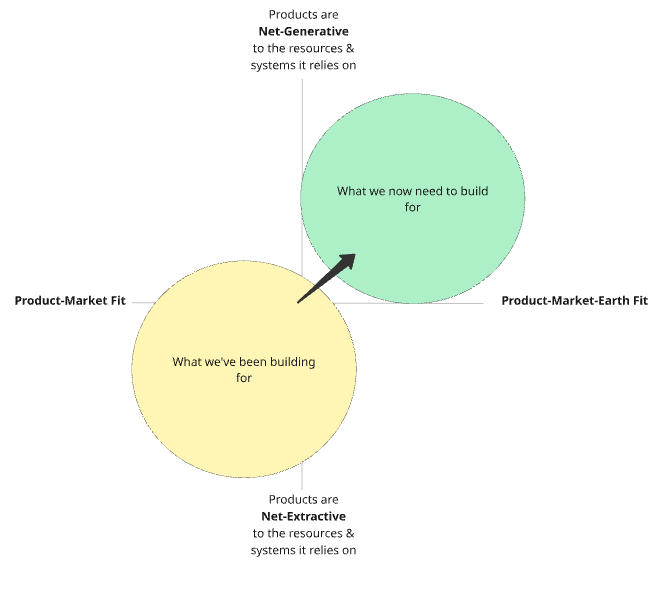
Product-Market Fit typically produces products that are net-extractive to the resources and systems they rely on. By contrast, teams working with us through PRODUCT-MARKET-EARTH FIT can produce products that are net-zero or net-generative to those same resources and systems.
Upgrading the Way We Define “Good Product”
Rather than patching old habits, it is time to upgrade the operating system itself: the way we define success, the way we make tradeoffs, the way we measure impact, and the way we imagine what “great product” truly means. A product does not just live in an app store or in a cloud, which means the upgrade begins by widening our field of view — from users and markets alone to the physical systems our work depends on and affects.
The good news is that nothing about this shift requires abandoning what makes product work powerful. We do not need to discard human-centered design, agile collaboration, experimentation, or prioritization frameworks. We simply need to extend them to reflect the full reality of impact.
Environmental considerations are not an “extra” or a separate track. They are already embedded in everything we build. Every design choice already shapes user behavior. Every feature consumes energy. Every system runs on physical infrastructure. Every roadmap decision influences what grows and what does not.
When we upgrade our definition of “good product,” we unlock a different kind of growth. Growth that strengthens instead of strains, that reuses and regenerates instead of merely extracts, and that recognizes users, markets, and the planet as deeply interconnected, because they always were.
This is the shift from an extractive paradigm that prioritized speed and scale above all else, toward pragmatic sustainable practices that reduce harm, and ultimately toward regenerative approaches that restore and replenish the systems they touch. A product that grows while undermining the foundations it relies on is not a success story; it is a short-term illusion.
This transition is not idealistic. It is necessary. It is practical. And it is increasingly good business.
Introducing PRODUCT-MARKET-EARTH FIT™
PRODUCT-MARKET-EARTH FIT™ (PME Fit) is the name Renee Davis and Anuradha Sanghvi give to the product strategy work they provide — expanding the classic Product-Market Fit question to include not only people and profit, but also the planet.
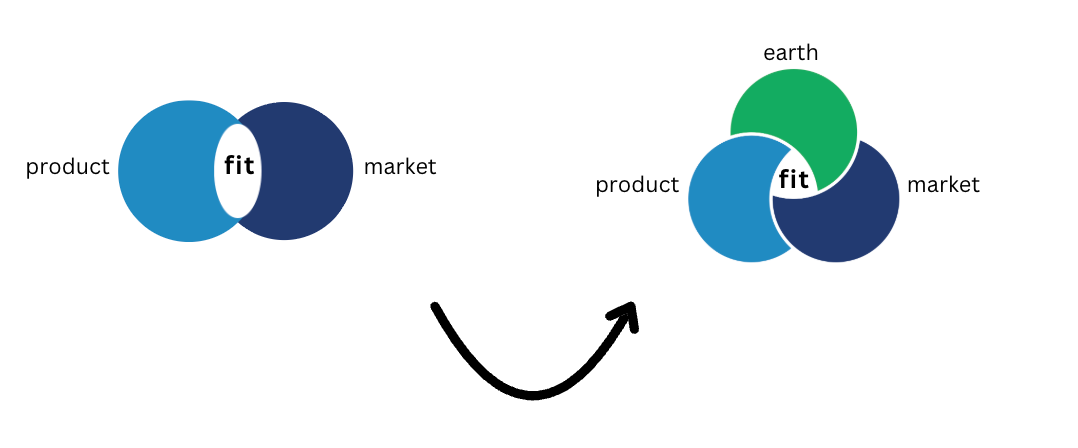
For over two decades, Product-Market Fit has been the default test for a product's success: is there a market, and can it be served profitably? That test says nothing about whether the systems a product depends on can keep sustaining it.
Consider the simple but radical truth: every product exists within Earth's finite ecological boundaries. Every feature shipped, every data pipeline, every manufacturing line interacts with real resources such as energy, minerals, water, and land. The question is no longer whether our products can scale, but whether they can scale responsibly.
The good news is product teams can find that "winning formula" by applying a practical climate lens — integrating environmental intelligence into product strategy from day one. Rather than replacing Product-Market Fit, we can build upon it. We can leverage new, modern climate-conscious frameworks to bridge business innovation and planetary stewardship.
The next chapter introduces EARTH — the framework Renee Davis and Anuradha Sanghvi use to turn PRODUCT-MARKET-EARTH FIT™ into stage-by-stage action.
Our Responsibility in Taking the Best Next Step
PRODUCT-MARKET-EARTH FIT™, as Renee Davis and Anuradha Sanghvi deliver it, does not demand perfection — it asks for progress. It helps teams move along an innovation spectrum from Extractive → Sustainable → Regenerative:
- Extractive: Growth optimized without regard for resource intensity or downstream impact.
- Sustainable: Environmental harm is reduced through efficiency, cleaner energy, and smarter design.
- Regenerative: Products actively restore systems — reducing emissions beyond their footprint, enabling better decisions, or strengthening community and ecological resilience.
To show what this work looks like in practice, let’s consider an everyday consumer product: an electric toothbrush. On the surface, it’s a simple device designed to improve oral hygiene. But beneath that simplicity are dozens of product, market, and environmental decisions that shape how the toothbrush creates value — and how it impacts the world.
The tables below show how those decisions evolve across the extractive, sustainable, and regenerative spectrum — revealing how progress is driven not by intention alone, but intentionally by design.
| Dimension | Extractive | Sustainable | Regenerative |
|---|---|---|---|
| Value Proposition | Value driven by premium features and frequent replacement | Effective oral care with lower resource intensity | Improved long-term oral health outcomes (fewer cavities, gum disease incidents) while reducing material and energy use per user over time |
| Default Product Experience | High-powered modes always on, regardless of need | Smart modes optimize power and duration | Clinically effective brushing with minimum necessary energy, extending device and brush-head lifespan without compromising care |
| Behavioral Design | Encourages overuse and unnecessary consumption | Guides users toward dentist-recommended habits | Habit formation that reduces unnecessary brushing intensity and frequency, lowering waste, wear, and energy use |
| User Feedback & Nudges | Engagement-focused gamification | Feedback tied to brushing quality and efficiency | Outcome-based feedback (health improvement, waste avoided) that reinforces sustained healthy behavior |
| Data & Intelligence | Collects granular data with limited user value | Data minimized to improve effectiveness | Aggregated, privacy-safe insights improve product design and oral health outcomes across the user base |
| Dimension | Extractive | Sustainable | Regenerative |
|---|---|---|---|
| Customer Relationship | Transactional, replacement-driven | Retention through performance and trust | Long-term partnership focused on health outcomes, not consumption cycles |
| Success Metrics | Units sold, subscriptions, engagement | Retention, satisfaction, efficiency gains | Measured improvement in oral health, reduced waste per customer, and higher lifetime value without increased material throughput |
| Incentives & Growth Model | Revenue tied to consumption and disposability | Revenue aligned with durability and efficiency | Revenue decoupled from physical consumption, rewarding longevity, reuse, and positive outcomes |
| Dimension | Extractive | Sustainable | Regenerative |
|---|---|---|---|
| Energy Efficiency | Inefficient motors and frequent charging | Energy-efficient motors and optimized charging | Net reduction in energy use per brushing session and per year, even as adoption scales |
| Resources | Mixed plastics, sealed, non-repairable | Reduced plastic use and improved durability | Significant reduction in virgin plastic use, increased recovery and reuse through modular, repairable design |
| Lifecycle | Disposable heads designed for frequent replacement | Longer-lasting heads with clear guidance | Closed-loop systems (return, refill, compostable heads) that reduce waste entering landfills |
| System Impact | Scales plastic waste and energy use | Reduces per-user footprint | Total system benefit improves with scale: less plastic waste, lower lifecycle emissions, stronger circular material flows |
Our responsibility as product leaders is not to solve climate change alone, but to make better-informed decisions at every stage of the product lifecycle — from discovery to delivery, from infrastructure choices to end-of-life considerations.
The best next step is rarely dramatic. But taken collectively, these steps compound — just like product decisions always have.
Chapter 03
Putting PRODUCT-MARKET-EARTH FIT™ Into Practice with the EARTH Framework
The E-A-R-T-H framework is how Renee Davis and Anuradha Sanghvi put PRODUCT-MARKET-EARTH FIT™ into practice. It is the structured, stage-by-stage method they use with teams on real product decisions. It breaks down into five levers: Energy footprint, user Actions, Resource optimization, Total impact, and sustainable Habits. Each lever is a lens your team can apply at any point in the product lifecycle, from discovery to delivery to end-of-life.
The Five Levers
- E — Energy Footprint: Understand and reduce the energy your product consumes across its full lifecycle: compute, storage, data transfer, devices, and the infrastructure that supports them. Ask where energy is spent, whether it is proportionate to the value delivered, and what a leaner path to the same outcome looks like.
- A — User Actions: Shape what your product asks of people. Every default, prompt, and workflow nudges behavior — toward sustainable choices or extractive ones. Design interactions so the sustainable action is the easy, default action.
- R — Resource Optimization: Treat materials, compute, storage, and data as finite resources rather than free inputs. Favor durability, repairability, efficient architectures, and the removal of waste — features, data, and infrastructure that no longer serve a purpose.
- T — Total Impact: Look past per-unit efficiency to the footprint of the whole system at scale. A product that is efficient per user can still be extractive in aggregate. Measure total energy, carbon, water, and material impact as adoption grows.
- H — Sustainable Habits: Build products that make sustainable behavior stick. Reinforcing loops — feedback, defaults, and rewards — turn one-time green choices into durable habits for users and durable practices for teams.
How to Apply It
Start where your team already works. In discovery, use the five levers to frame questions about the problem space: where does this product draw on energy, materials, and user behavior? In definition and design, use them to evaluate trade-offs between competing solutions. In delivery, use them to set targets alongside your existing performance metrics. And in operation, revisit them as your product scales — because impact compounds just as usage does.
You do not need to act on all five levers at once. The framework is a map, not a mandate: pick the highest-impact lever for your product and stage, make progress there, and expand from there. Progress along the spectrum from Extractive to Sustainable to Regenerative is the goal — not perfection on day one.
Chapter 04
Case Study: A Product-Market-Earth Fit Engagement
In this case study we'll walk through an illustrative example showing how product teams can embed climate consciousness into every stage of the product development lifecycle. It's not just about adding features — it's about redefining success, shaping business models, and optimizing execution so that every decision advances both user impact and planetary sustainability.
The example highlights measurable outcomes, showing how teams can track adoption, engagement, and growth alongside energy savings, carbon reduction, and resource efficiency — proving that profitable, high-performing products can also be climate-conscious.
Case Study: Green Video Conferencing
Meet the product: a popular video conferencing platform used by millions daily, running on the classic operating system.
- North Star: Product–Market Fit focused on customer adoption
- Growth Engine: Subscriptions for growth
- Execution Tools: Agile and OKRs
The challenge: millions of HD meetings consume significant electricity, users leave default HD video on, and those habits reinforce high-energy patterns.
The Solution
Using the EARTH framework introduced in Chapter 3, here’s how Renee and Anu work through PRODUCT-MARKET-EARTH FIT for this product:
- ⚡ Energy Footprint: reducing the power a product consumes to operate
- 👤 User Actions: giving users visibility and control over their own impact
- 📦 Resource Optimization: minimizing the materials, storage, and infrastructure a product depends on
- 🌎 Total Impact: accounting for the product's full footprint, not just the parts that are easy to measure
- 🔄 Sustainable Habits: designing defaults and nudges that reinforce lower-impact behavior over time
| Stage | PM Actions | Regenerative Outcomes using E-A-R-T-H |
|---|---|---|
| Identify | Analyze which meetings consume the most energy and identify High Definition (HD) settings driving high electricity use. | ⚡ Reduce energy by shifting meetings to green servers • 📦 Identify opportunities to reduce server load and waste • 🌎 Target high-impact opportunities to lower total carbon footprint |
| Design | Design Adaptive Resolution to prioritize main speaker HD and implement an Eco Mode toggle with real-time carbon feedback. | ⚡ Reduce per-meeting energy use • 📦 Reduce resource usage by optimizing video streams and bandwidth • 🔄 Reinforce sustainable habits via UX nudges |
| Build | Implement features, add telemetry to measure energy and carbon impact, and pilot with enterprise clients. | ⚡ Deliver an energy-efficient platform • 👤 Highlight and reward low-energy user behaviors • 🌎 Communicate environmental benefits to users |
| Test & Iterate | Track Eco Mode adoption, energy consumption, and habit formation; refine UX nudges and dashboard metrics. | ⚡ Improve energy efficiency over time • 🔄 Strengthen sustainable habits • 🌎 Increase regenerative impact through data-driven iteration |
Working through PRODUCT-MARKET-EARTH FIT on this example lets product managers focus on the highest-impact levers at each stage of product development — energy efficiency, resource optimization, and reinforcing sustainable habits — creating meaningful change without overwhelming the team.
And the best part? This approach isn't just good for the planet, it's good for business too! Teams working with us often see reduced costs, improved efficiency, increased user trust, and stronger user engagement. This is proof that doing well and doing good can go hand in hand.
What Changed for Green Video Conferencing
- A higher bar for what success means: : Success is measured not just by adoption, engagement, or revenue, but also by planetary impact. Every roadmap choice, feature, and user interaction considers energy, resource use, and regenerative outcomes.
- A sustainable business model: : Scale is designed sustainably. Revenue and engagement grow without increasing environmental cost, with features like adaptive resolution, Eco Mode, and optimized server usage. Resources are reused or minimized, making the business model regenerative rather than extractive.
- Sharper execution, powered by EARTH: : Frameworks like Agile, Lean, and OKRs are enhanced with the EARTH lens. PMs prioritize the highest-impact elements at each stage: energy ⚡ during identification, resources 📦 during design and build, and user agency 👤 and sustainable habits 🔄 during iteration. Continuous feedback — measure, learn, iterate, improve — ensures small improvements compound into meaningful planetary impact.
This is what an operating system update looks like in practice — not a single leap, but decisions that compound, meeting after meeting, product after product. Green Video Conferencing is one product, one team, one set of decisions. But it's proof of what's possible through a PRODUCT-MARKET-EARTH FIT™ engagement with Renee Davis and Anuradha Sanghvi, applying the EARTH framework deliberately, stage by stage.